The rules
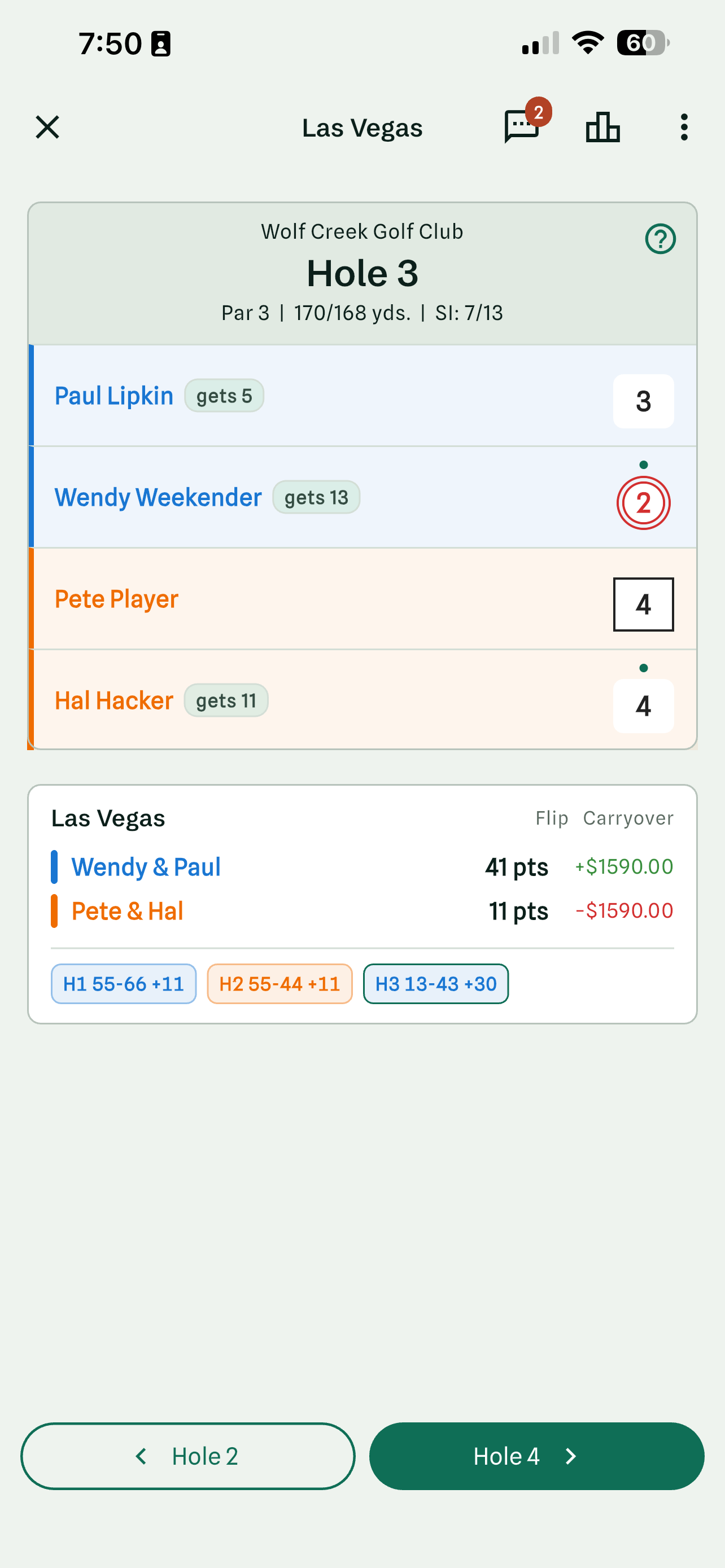
Split the four of you into two teams before you tee off. Both golfers on a team play their own ball all the way out — there is no best ball and nothing to concede. At the end of the hole each team makes a number out of its two scores, and the two numbers are compared.
The margin is the difference between the numbers, not one point for the hole. That is the whole character of the game: a routine hole is worth eight or ten points, and a hole where somebody loses a ball is worth fifty.
1
Pick the teams
Two and two, drawn or agreed. Most groups keep them for the round; some redraw at the turn.
2
Everybody holes out
Both scores count on every hole, which means the second ball matters as much as the first.
3
Make the number, take the difference
Low score first, apply any flip, subtract. The points go into a running total for the round.
Building the number
One rule, and one exception that comes up more than you would think.
Lower score in front
Always, unless somebody hits double figures.
A ten or worse goes in front. A 6 and a 10 is 106, not 610 — otherwise a single blow-up hole would be worth six hundred points and the round would be over.
Why the second ball is the whole game
In a best-ball game your partner making seven costs you nothing at all. Here it goes straight onto the back of your number. A team that goes 4 and 7 makes 47; the same team with a 4 and a 5 makes 45. Nobody is carried in Las Vegas, and every shot the second ball drops is a point off the hole.
The flip
A birdie by anybody on your team reverses the other team’s number. Their 47 becomes 74. Nothing changes about your own number — you just make theirs as expensive as it can be. This is what turns Las Vegas from arithmetic into a gambling game, and it is the rule most groups get wrong on the first tee.
Birdie
Flip the opponents’ number once. Two birdies on the same team flip it once, not twice — the number is already the wrong way round.
Eagle
Flip, then double the whole hole. Groups differ on whether an eagle flips a number a birdie already flipped; the tidy answer is that the number is flipped once and the doubling does the rest.
Both teams birdie
Both numbers flip. It happens on the short par fives, and it usually leaves the hole roughly where it started — which is the point. You matched them.
The order matters
Build both numbers first, then apply the flips, then subtract. Doing it the other way round — reversing the digits as you write them down — is how a hole ends up scored twice and nobody can work out why the totals do not agree at the turn.
Scoring, worked all the way through
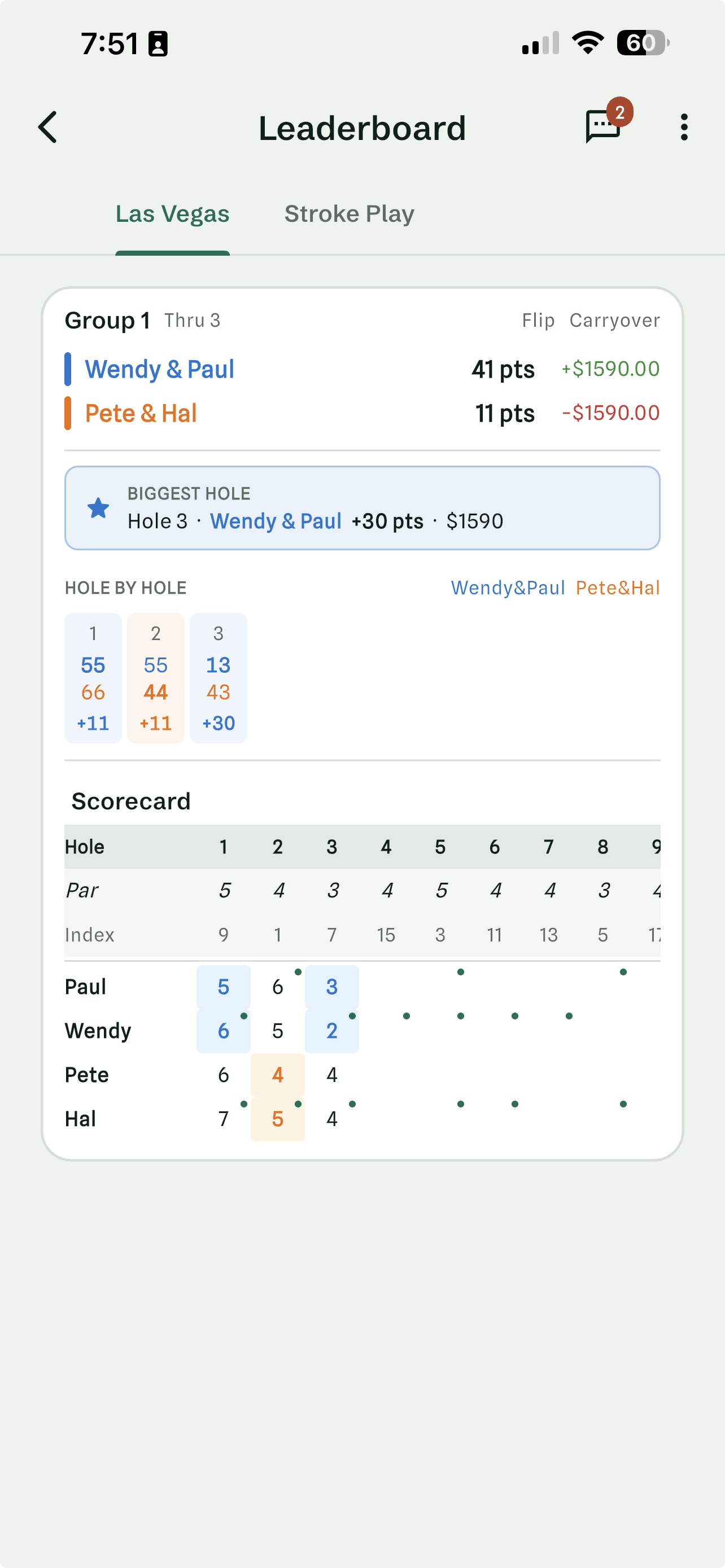
Paul and Dave against Sam and Lee, at ten cents a point — the three holes from the diagram above.
Hole 1 — a normal hole
par 4
Paul 4, Dave 5. Sam 5, Lee 6. No birdies, so nothing flips.
Hole 2 — a hole where nothing happens
par 4
Paul 4, Dave 5 again — 45. Sam and Lee both make par, so they are 44. No birdies, so nothing flips, and one shot on the card is the whole hole.
PAUL & DAVE — 45
−1
45 − 44
Hole 3 — the one that hurts
par 4
Dave holes a birdie putt for 3 and Paul makes par, so they are 34. Sam makes 5 and Lee takes 8, so 58. Dave’s birdie flips 58 into 85. One hole, fifty-one points, and Lee is the reason.
SAM & LEE — 58 FLIPPED TO 85
−51
85 − 34
AFTER THREE HOLES
Paul & Dave
+61
$6.10, or $3.05 each
Sam & Lee
−61
$3.05 each out
Two ordinary holes were worth twelve points between them. The third was worth fifty-one on its own. That is the shape of every Las Vegas round — nothing much happens, and then everything happens at once.
Picking a stake
The one thing to get right before you tee off. Points in Las Vegas run an order of magnitude higher than in any other golf game, so the per-point number has to be an order of magnitude lower. Ten cents a point is the standard.
5¢ A POINT
$8–15
a typical round
10¢ A POINT
$15–30
the usual game
25¢ A POINT
$40–90
know your group
A round usually settles somewhere between 150 and 300 points. Multiply the point value by 250 and ask whether you would be happy losing that.
House rules worth agreeing on the first tee
Las Vegas has more variants than most, because every group finds its own way to cap the damage. Settle these before you start.
Is there a maximum score on a hole?
Most groups cap an individual at double par, or at triple bogey, and write that number down instead of what actually happened. Without a cap, one lost ball on a par five can be worth more than the rest of the front nine put together. Capping is the single most common house rule in the game.
Do the teams change?
Fixed teams for eighteen is simplest. The livelier version rotates every six holes so everyone partners everyone, and the round becomes three separate matches — which also means nobody spends the whole day tied to the one man who is out of form.
Handicaps, or straight up?
Net scores work fine and matter more here than elsewhere, because a stroke does not just win a hole — it changes a digit. A stroke that turns a 6 into a 5 moves your number by ten points if it is the back digit, and by ten times that if it reorders the pair.
Does an eagle really double?
Some groups double, some triple, some do nothing beyond the flip. Doubling is the common one. Whatever you pick, say it out loud on the first tee, because the hole it comes up on is always a big one.
Scoring Las Vegas without doing the arithmetic
Las Vegas looks easy and is not. Every hole you have to order two pairs of digits, check whether a ten belongs in front, work out who birdied and whose number it flips, subtract, and then add a two-digit result to a running total that is already in the hundreds. Miss a flip on the fourth hole and the number in the car park is wrong.
Halved does that part. Post gross scores like any other round. It builds both numbers, applies the flips and the cap, keeps the running total in dollars, and shows the whole group the same figure.
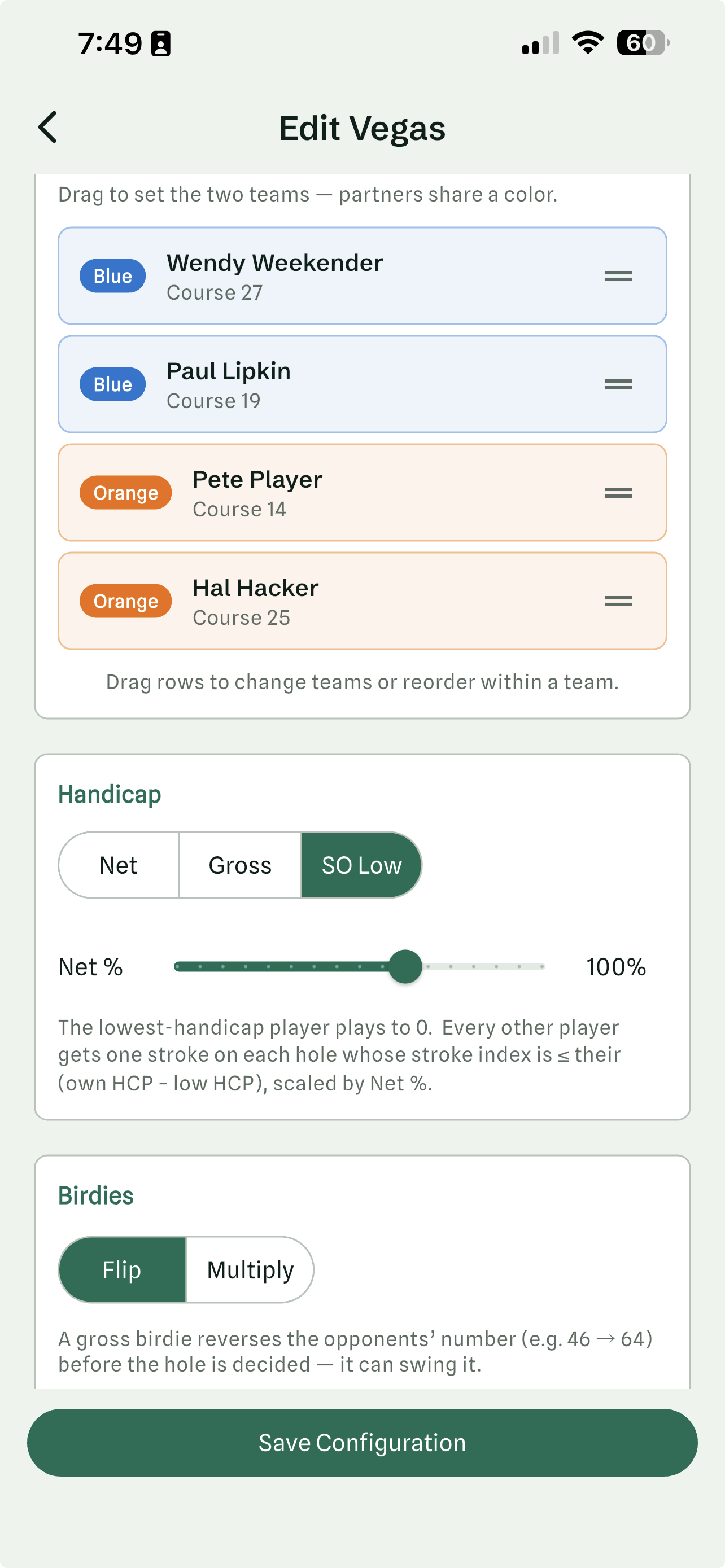
The flips are automatic
It knows a 3 on a par 4 is a birdie and reverses the other number without being asked.
Your cap, enforced
Set double par or triple bogey once and blow-up holes stop being an argument.
Points shown in money
Four hundred and forty points means nothing. $4.40 each means something.
Play Las Vegas. Let something else keep score.
Free for the group, flips applied automatically, and the settlement is done before you get to the car park.
Questions people ask
Why is it called Las Vegas?
Because of the swing. Points come in twos and threes on the ordinary holes and then fifty at once on the hole where somebody makes eight, which is a good deal more like a casino than a golf bet. The name is also a warning about the stake.
Can you play Las Vegas with three or six golfers?
It needs even teams, so four or six. With six you make three-digit numbers, which sounds absurd and plays fine as long as the cap is tight. With three there is no version that works; play
Wolf instead.
What happens if both teams make the same number?
Nothing. The difference is zero, so the hole is halved and no points change hands. It is rarer than it sounds, because the two numbers have to match on both digits.
Should we cap the hole score?
Yes, unless everybody in the group is a single-figure handicap. Double par is the usual cap. Without one, Las Vegas stops being a game of golf and becomes a game about who has the worst hole, and the man who has it stops enjoying his round.