The rules
Before you tee off, put the four of you in an order. That order is the rotation, and it never changes: first golfer is the Wolf on hole 1, second on hole 2, and so on round and round. Over sixteen holes everyone gets four turns.
The Wolf tees off last. That is the whole engine of the game — he stands on the tee having seen three drives, knowing exactly what is on offer, and has to commit before anyone plays a second shot.
1
Set the rotation
Draw it at random on the first tee. Who goes first matters less than everyone knowing the order.
2
Three drive, Wolf watches
The other three hit in any order. The Wolf hits last, then makes the call.
3
Play it out, settle the hole
Best ball each side. The hole is settled on its own and the points go straight into the running total.
A rotation, in full
Paul, Dave, Sam, Lee — drawn in that order on the first tee.
The three choices
Everything the Wolf can do on a tee, and what each one is worth. The point values below are the common ones; groups change them all the time.
Take a partner
The safe play, and the one that happens most. The Wolf names one of the other three and it becomes a two-against-two best-ball hole. Both sides count their better net score.
Lone Wolf
Turn all three down and play the hole alone against the best ball of the other three. Triple points if you take it, and the same triple out of your pocket if you do not.
Blind Wolf
Declare alone before anybody tees off, drives unseen. Double what a Lone Wolf pays. Called about twice a season, usually on a short par four by a man who is losing.
The one rule people forget
The pick has to be made before the next shot is played. You cannot walk up the fairway, see how the lies turned out, and then choose. Once someone has hit an approach, the Wolf is committed to whatever he said on the tee — or to going alone if he said nothing.
Scoring, worked all the way through
Wolf scoring is zero-sum. Every hole nets to nothing: whatever the winning side takes, the losing side pays between them. That one property is what makes the running total trustworthy, and it is also what makes it a nuisance to do in your head.
Three holes from the same round, at a dollar a point.
Hole 6 — Dave takes a partner
par 4
Paul bombs one down the middle, so Dave picks him. Net scores: Paul 4, Dave 5, Sam 5, Lee 5.
DAVE & PAUL
+1 each
best ball 4
SAM & LEE
−1 each
best ball 5
Hole 7 — Sam goes Lone Wolf
par 3
Three mediocre tee shots, and Sam knocks it to twelve feet. He turns them all down. Net: Sam 2, best of the other three 3.
THE OTHER THREE
−1 each
they split it
Hole 8 — Lee goes Lone Wolf and misses
par 5
Same call, worse result. Lee makes six; Paul makes a net four. The triple runs the other way.
LEE, ALONE
−3
pays all three
THE OTHER THREE
+1 each
for turning up
AFTER THREE HOLES
The four numbers add to zero, and they will still add to zero on the eighteenth. That is the check worth doing if you are keeping it on the back of the card — if the column does not sum to nothing, a hole got scored wrong.
Holes 17 and 18
Four golfers into eighteen holes does not divide. The rotation covers sixteen, and the two that are left over go to whoever is losing: last place is the Wolf on 17, and last place after 17 is the Wolf on 18.
Treat that as the game rather than a variant. A rotation that just runs out leaves the man who is down with two holes and nothing to play for, and the closing stretch is exactly where a Wolf game should have something at stake. Being handed the wolf twice, with a triple available on both, is a real way back — and it is why nobody in a Wolf game is ever out of it walking off the sixteenth.
House rules worth agreeing on the first tee
Wolf has been played a hundred ways. None of these is wrong. Settle them before you tee off, because every one of them changes who wins.
Does the Wolf pick after each drive, or after all three?
The tighter old version has the Wolf teeing off first and deciding on each golfer the instant his ball lands — pass on a good drive and it is gone for good. Letting the Wolf hit last and choose from all three is friendlier and quicker, and it is the more common game now. The old way produces far more Lone Wolves.
What happens on a tie?
Simplest is that a halved hole pays nobody, which is what most groups do. Some make the Wolf lose ties, on the grounds that he had the pick and the advantage that comes with it. That one bites hardest on a Lone Wolf, where a tie turns into a triple loss.
Handicaps, or straight up?
Gross is simplest and favours the good player. Strokes off the low man is the better way to handle handicaps here: the best player gets nothing, everyone else plays the difference, and those strokes fall on the hardest holes. It matters more in Wolf than in most games, because a stroke is what makes a high handicapper worth picking.
Is there a bonus for beating a Lone Wolf?
Some groups pay the pack double when they beat a Wolf who went alone, which makes going alone genuinely brave rather than just expensive. Others cap what any one player can lose over the round, which keeps a bad day from turning into a real one.
Scoring Wolf without doing the arithmetic
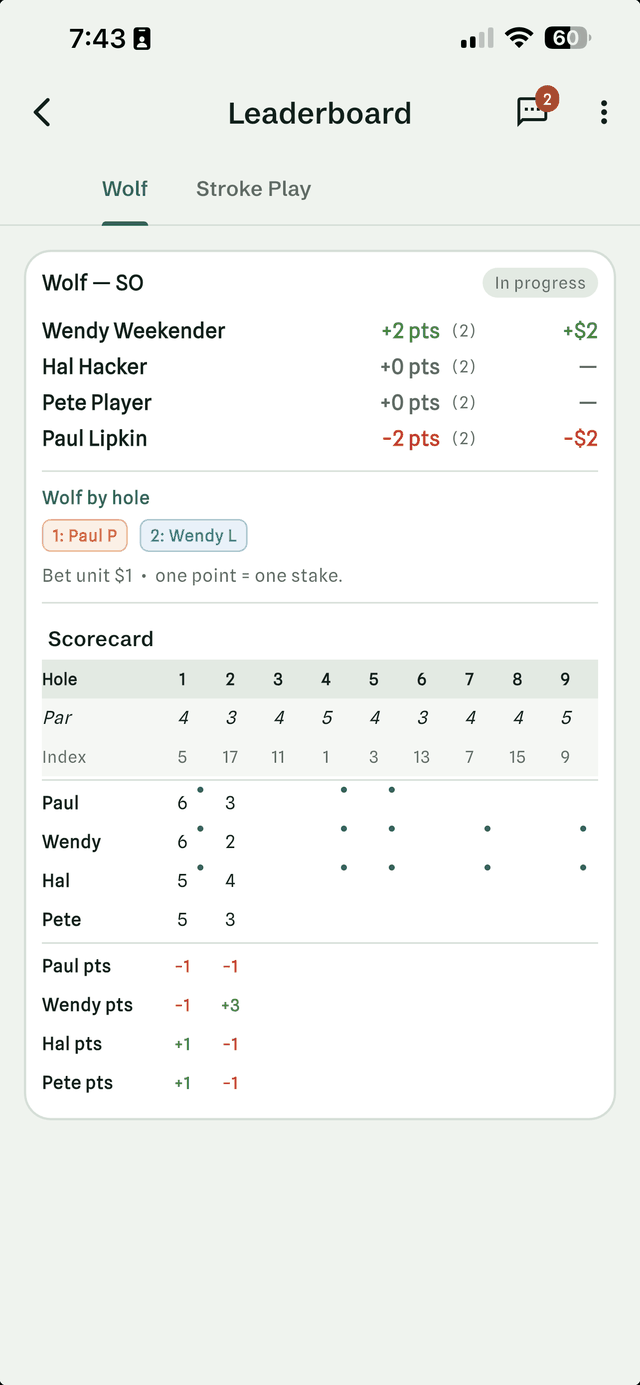
Wolf is the hardest of the common golf games to keep on paper, and it is worth being honest about why. Every hole you have to remember whose turn it was, what he chose, which side won it after strokes, and then push a different number into four different columns — three of them negative. Miss one hole and the total is wrong for the rest of the day.
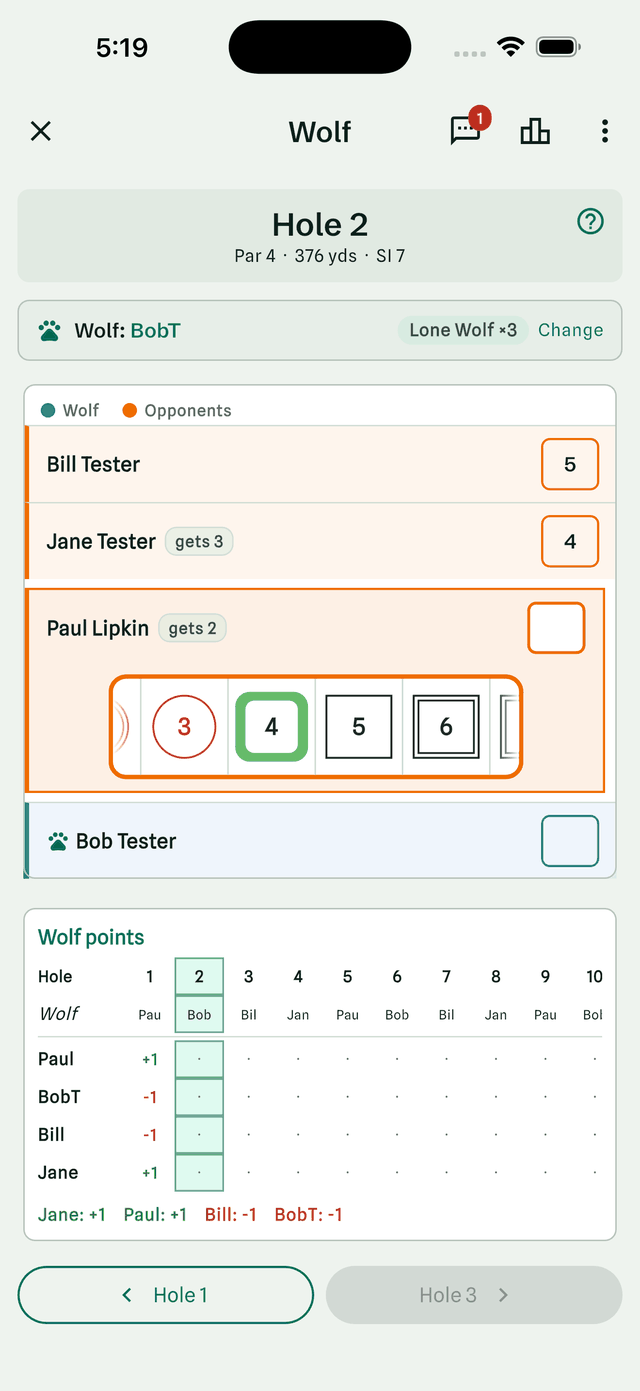
Halved does that part. You post gross scores like any other round. It knows whose wolf it is, asks for the pick on the tee, applies the strokes, and keeps everyone’s number in dollars where the whole group can see it.
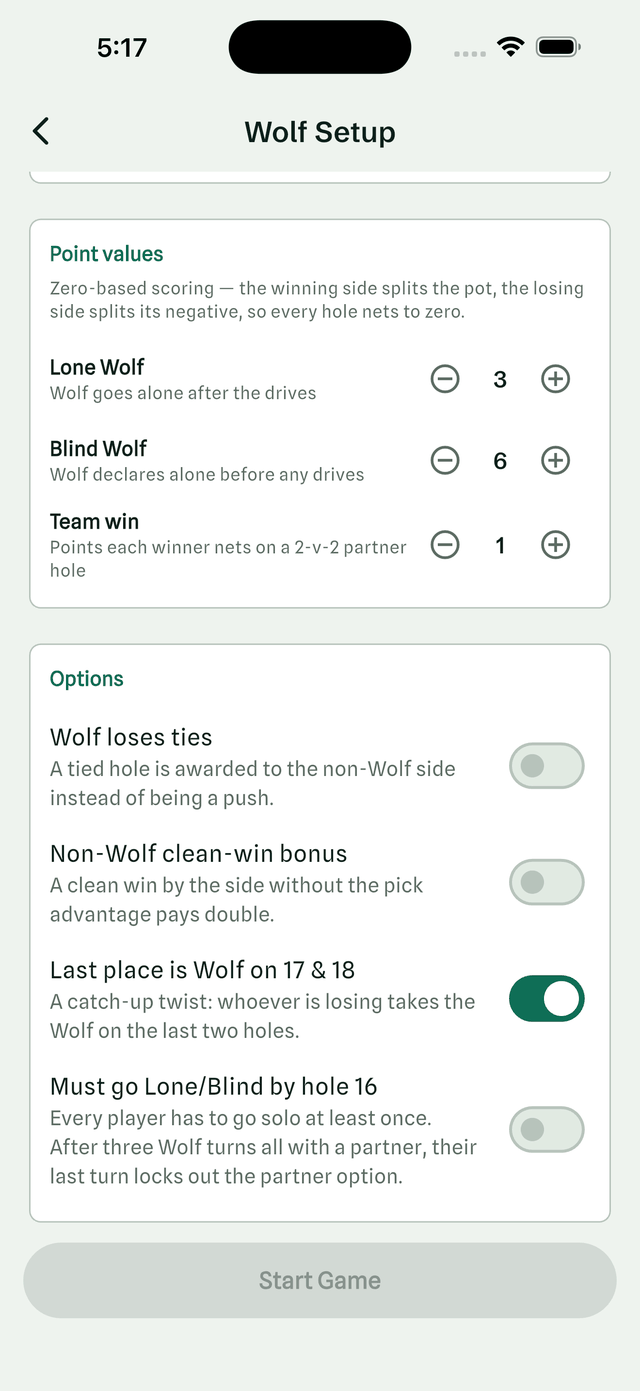
It asks on the tee
Partner, Lone or Blind, with the points each one is worth right there on the buttons.
Your house rules, kept
Point values, ties, handicap method and the loss cap are all settings. Set them once.
Everyone sees the same total
One golfer enters, the group watches. No reconciling four cards in the car park.
Play Wolf. Let something else keep score.
Free for the group, no card to enter, and the settlement is done before you get to the car park.
Questions people ask
Can you play Wolf with three golfers?
Yes, though it changes the game — the Wolf picks from two, and going alone is one against two rather than one against three, so the triple is usually cut to double. The rotation covers eighteen holes exactly with three, which does mean no catch-up holes at the end.
What is a good stake for Wolf?
A dollar a point is the usual starting place. Worth knowing before you agree to it: the worst realistic day is losing every hole as the pack and getting caught on a few Lone Wolves, which lands somewhere near thirty times the point value. If that number is uncomfortable, halve the stake rather than the fun.
When should you actually go Lone Wolf?
Two situations. Your ball is stiff on a par three and nobody else is inside twenty feet. Or you are down late, the arithmetic says a partner hole will not catch you up, and the triple is the only thing that will. Going alone because all three drives were poor is the common mistake — you still have to beat the best of three balls, and one of them will make par.
Is Wolf the same as Hollywood or Sixes?
No, though they get confused. In the partnerships are fixed for six holes at a time and everyone eventually partners everyone. In Wolf the teams change every hole and one golfer chooses them. Wolf is the one with the gamble in it.