The three-ball game. Worst score on the hole is knocked out, the two left standing play for the money, and the moment it is settled a fresh one starts on the next tee. And under the Zombie rule the man you just buried can climb back out.
THE SHORT ANSWER
Three golfers all ante the stake. On each hole the worst net score is eliminated; the two who are left play the next hole as a decider, and the lower score takes the pot. Then everyone is back in and the next Survivor begins — up to nine of them in a round.
SURVIVOR 3 · ZOMBIE RULE ON
out, then back
ZOMBIEVILLE
HOLE 7HOLE 8HOLE 9
NET
Paul
—454
Dave
—564
Sam
—635
🧟
🧟
WORST — OUT
LOW OUTRIGHT — BACK IN
WORST — OUT
TIED — STAYS DEAD
TAKES THE POT
Hole 7. The three net scores go in one at a time.
Sam’s six is the worst, so he goes to Zombieville. Paul and Dave are the decider.
Hole 8. Sam is still on the card, playing from the dead.
His three beats both deciders, so Sam is promoted out — and Dave takes his place.
Hole 9. Dave putts from Zombieville and matches Paul’s four.
A zombie has to win outright, so the tie does nothing. Paul takes the pot; Dave stays put.
3
golfers
2
holes, minimum, per Survivor
9
Survivors in a round, at most
~3
min to learn
The rules
Survivor is the answer to the three-ball. Most golf bets want an even number of players; this one only works with an odd one, because the whole game is that somebody has to be the worst.
All three ante the stake into a pot. From there each Survivor runs in two phases, and it takes at least two holes to settle one.
1
ELIMINATION
Worst score goes out
Everyone posts a net score and the high man is knocked out of this Survivor. He keeps playing his own round; he just cannot win this pot.
2
DECIDER
Low of the two takes it
The two survivors play the next hole head to head. Lower net score wins the pot: two stakes in, one comes back doubled.
What the pot pays
At $5 a Survivor, with all three anteing.
WINNER
+$10
LOSING DECIDER
−$5
ELIMINATED
−$5
Settle a Survivor and the next one starts on the very next hole, all three back in. A clean round of two-hole Survivors gets you nine of them.
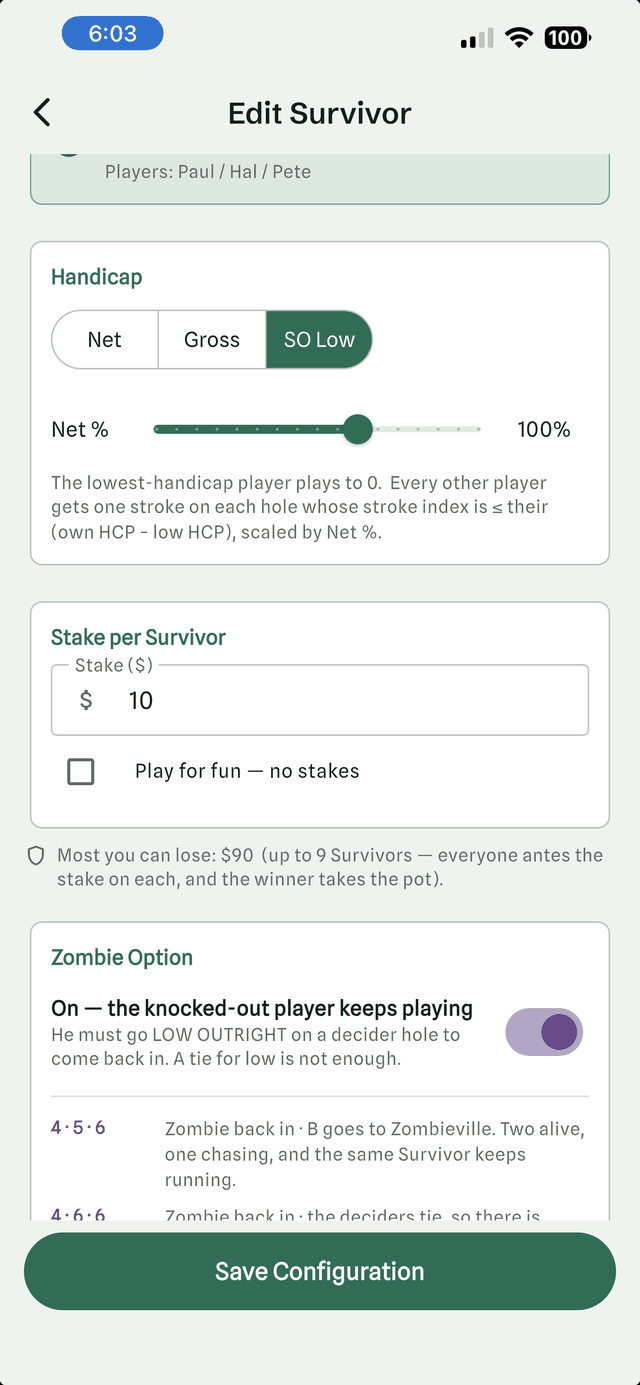
Handicaps are worth settling before you start. Playing strokes off the low man is the usual choice: the best player gets nothing, the other two get the difference, and those strokes fall on the hardest holes of the round rather than being spread across a Survivor — nobody knows how long one will last until it ends.
Ties, and what happens on 18
Ties are where three-player games usually fall apart. Survivor handles them by never resolving anything it cannot resolve cleanly — it just runs on to the next hole.
Two worst scores tie
Nobody goes out. All three stay in and the next hole does the eliminating instead.
The decider is halved
The pot carries. The same two play on until one of them is lower, so a Survivor can stretch four or five holes.
The eighteenth
There is no room to eliminate and then decide, so the last hole settles whatever is standing. With all three still in, low ball takes it and any tie for low is no blood. With two left, it is the decider. And a Survivor that reaches 18 without resolving pays nothing — no blood, nothing carried forward.
The Zombie rule
On by default, and the best thing in the game. The eliminated player stays on the card through the decider. He is a Zombie: dead, but still posting a score, and still able to do damage.
Win the decider hole outright — lower than both men who put you out — and you are alive again. Somebody has to take your place.
🧟
THREE WAYS A ZOMBIE HOLE ENDS
456
Low outright, deciders split
The Zombie is back in and the higher decider goes to Zombieville. Two alive, one chasing, and the Survivor carries on.
466
Low outright, deciders tie
Nobody to send out, so nobody goes. All three are alive again and the Survivor resets to the elimination phase.
556
Tied or worse
Nothing changes. The hole settles between the two deciders as normal, and the Zombie stays dead.
A tie is no good to a Zombie. He has to be alone at the bottom of the hole, which is the point — coming back should cost a putt that matters.
One consequence worth knowing on the first tee: with Zombie on, a Survivor can run a very long way. If it is still alive on the eighteenth it pays nothing, and a Zombie who wins the last hole kills that Survivor's payment outright. Nobody is ever safely ahead, which is either the appeal or the reason your group leaves it off.
Nine holes, worked
Paul, Dave and Sam, $5 a Survivor, Zombie rule on. Net scores, and every mark that matters called out.
Survivor 1 — holes 1 and 2
Sam makes six on the first and is out; that is also what opens Zombieville for the rest of this one. On the 2nd, Paul makes four to Dave's five — and Sam, the Zombie, makes five, which is not low outright. Paul takes the pot.
PAUL
+$10
DAVE
−$5
SAM
−$5
Survivor 2 — holes 3 to 6
A long one. On the 3rd Paul and Sam both make five, tied for worst, so nobody goes out. Same again on the 4th and the 5th. Finally on the 6th Dave makes four to two fives — but with all three still in, that is not a decider, it is the hole that settles it: low ball takes the pot.
DAVE
+$10
PAUL
−$5
SAM
−$5
Survivor 3 — holes 7 onward
ZOMBIE IN PLAY
Sam makes six on the 7th and goes out again. On the 8th Paul makes four, Dave makes five — and Sam makes three. Low outright, so he is alive and Dave goes to Zombieville in his place. Paul and Sam are the decider now, and this one runs into the back nine unsettled.
No money moves yet. If it never resolves, nobody pays — and if Sam wins it on the eighteenth as a Zombie, the same is true.
THROUGH EIGHT HOLES
Paul
+$5
Dave
+$5
Sam
−$10
Two Survivors settled, one still running. The column adds to zero — it always will, however many are in flight, and it is the one check worth doing if you are keeping this on the back of the card.
House rules worth agreeing on the first tee
Zombie on, or turn it off?
On is the default and the livelier game: longer Survivors, and nobody safely ahead. Turning it off makes Survivor short and predictable — most settle in two holes and everyone knows where they stand. Decide once, for the round; switching halfway is how arguments start.
Net, gross, or strokes off the low man?
Strokes off the low man is the fairest of the three in a mixed group, and it is what makes a high handicapper dangerous on a hard hole. Gross is simplest and favours the best player, which in a three-ball he will notice.
What is a sensible stake?
The worst case is losing every Survivor, so the exposure is the stake times the number that can settle — nine at most over eighteen holes. At $5 that is $45. Pick the stake off the number you would not enjoy paying, not off the number per hole.
Do you carry an unsettled Survivor?
The standard is no: one that reaches the eighteenth alive pays nothing. Some groups instead split its pot between whoever was still standing, which rewards surviving rather than winning. Both work; only one of them ends the round quietly.
Scoring Survivor without losing track of who is dead
The arithmetic in Survivor is easy. The bookkeeping is not. Which Survivor are we on, who is out of it, is this hole an elimination or a decider, did that tie stop the clock, and — with Zombie on — is the man on the green over there technically back in. Three golfers will remember three different answers.
Halved tracks the state. Post gross scores like any other round and the phase, the eliminations, the Zombie and the money look after themselves.
The hole tells you what it is
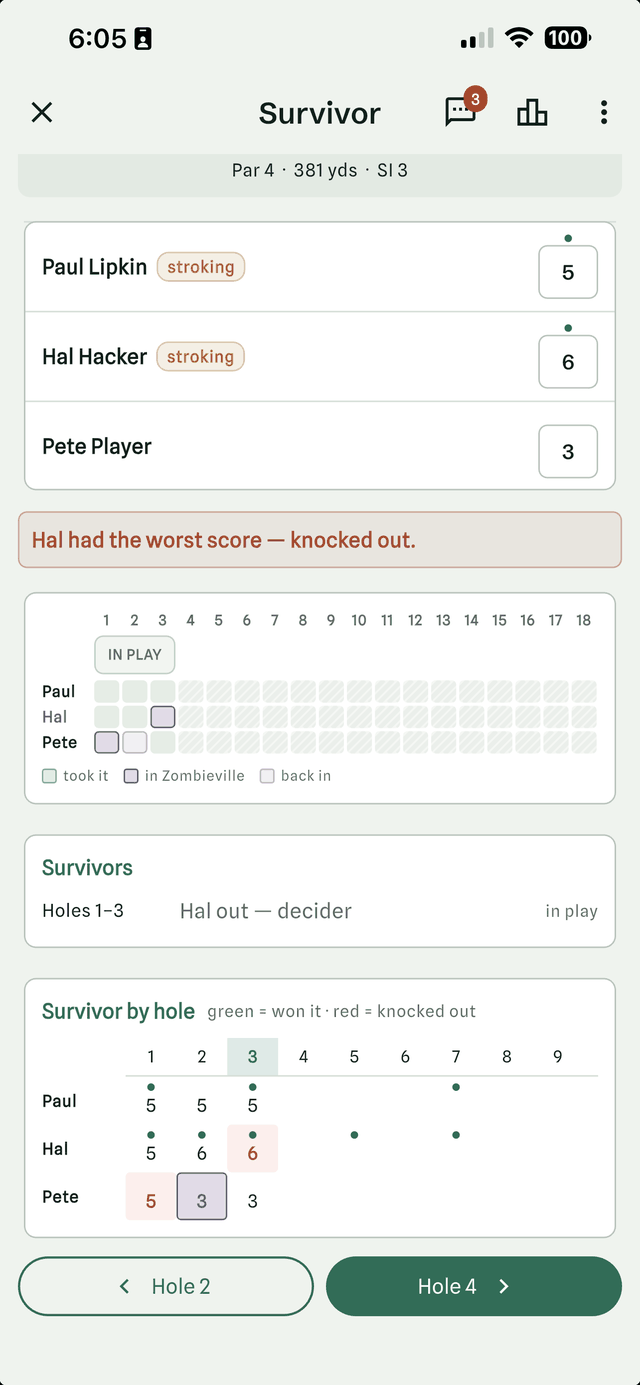
A banner at the top of every hole: which Survivor, elimination or decider, and who is playing for it.
The Zombie is on the card
Marked in plum, score still entered, and the moment it is low outright the app tells the group who just swapped places.
Every Survivor, by hole
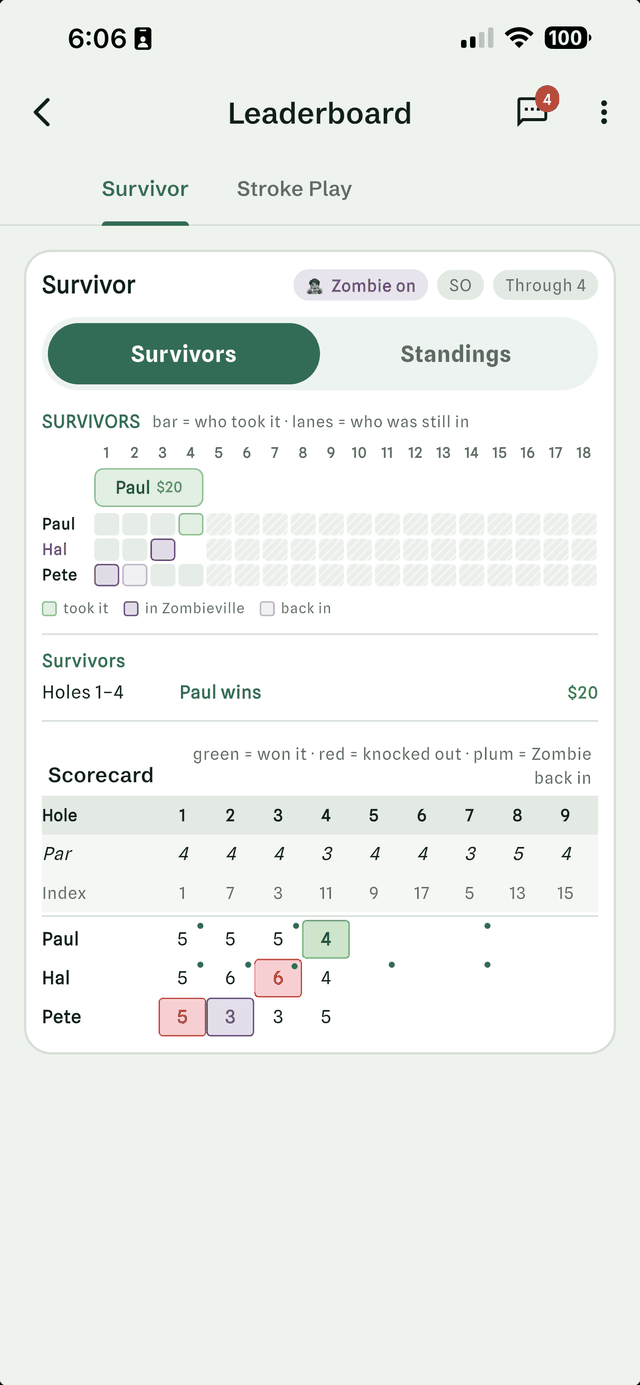
A strip showing who was in, who took it, and where Zombieville opened — so settlement comes off the record, not off memory.
Set the rules once
Handicap method, stake, and whether the dead get to come back.
Enter the score, read the verdict
Who is alive, who just went under, and whether this one settled.
Settle before the car park
Nine Survivors, one number each, adding to zero.
Play Survivor. Let something else remember who is dead.
Free for the group, built for the three-ball, and the settlement is done before you reach the car.
Three. Survivor is the standard answer to an odd group, because the game needs somebody to be the worst score on the hole. Four can play a version where two go out at once, but it is a different game and it settles far quicker.
What is the Zombie rule in Survivor?
The rule that keeps the eliminated player on the card. He posts a score through the decider hole, and if it is lower than both deciders outright he is alive again — the higher of the two takes his place. Ties do not count; the Zombie has to be alone at the bottom of the hole.
What happens if the two worst scores tie?
Nobody is eliminated. All three stay in and the next hole does the eliminating instead. The same principle covers a halved decider: the pot carries and the same two play on until one is lower.
Does an unfinished Survivor pay out on 18?
No. A Survivor still running on the eighteenth settles what is standing on that hole — and if it cannot settle, it pays nothing. Nothing is carried forward to a following round.
How much can you lose playing Survivor?
The stake times the number of Survivors that settle, nine at most in eighteen holes. At $5 a Survivor the worst possible day is $45, and that requires losing every single one.