One golfer takes on the whole group, one bet at a time, and the role moves every hole. It is the loudest game in golf because both sides can double — and the banker, who tees off last, gets to answer all three of them at once.
THE SHORT ANSWER
On each hole one golfer is the banker and every other golfer has a separate bet against him, set before the tee shots. Beat him on net and he pays you; lose and you pay him; tie and nobody pays. Lowest net on the hole banks the next one.
ONE HOLE · THREE BETS
Paul banks the 7th
HOLE 7 · PAR 4BAND $5–$50
PaulBANKER×2 COUNTER — ALL THREE
Dave×2 IN THE AIR$10→ $20→ $40
Sam$20→ $40
Lee$5→ $10
Paul has at risk$90
Paul banks the hole. Each of the other three names his own bet before anyone hits.
Dave likes his drive and doubles his own bet in the air — nobody else’s moves.
Paul hits last, then counters once: every standing bet doubles.
1 v 3
every hole
18
bankers in a round
×2
one counter a hole
$0
changes hands on a tie
The rules
Banker — also called Wolf’s cousin, Bridge, or simply the money game — is played hole by hole. On every hole one golfer is the banker and plays a separate match against each of the others. Three opponents means three independent bets, settled three different ways.
Each opponent chooses what his own bet is worth, inside a band the group agreed on the first tee. Beat the banker on net and he pays you that amount; lose and you pay him; tie and nothing changes hands. Nobody plays against anybody but the banker, so Dave winning has no bearing on what Sam owes.
Then the role moves. Lowest net score on the hole banks the next one, which is the rule that makes the game self-correcting: play well and you are immediately the one exposed to everybody.
Being the banker is not a reward
The banker can win three bets on one hole, and he can lose three. He is one score against three, so the arithmetic is against him — the reason to want the role is that he hits last and he holds the counter. Everything interesting about the game comes from that asymmetry.
The order of a hole
The sequence matters more here than in any other format, because each step is information the next player gets to use.
1
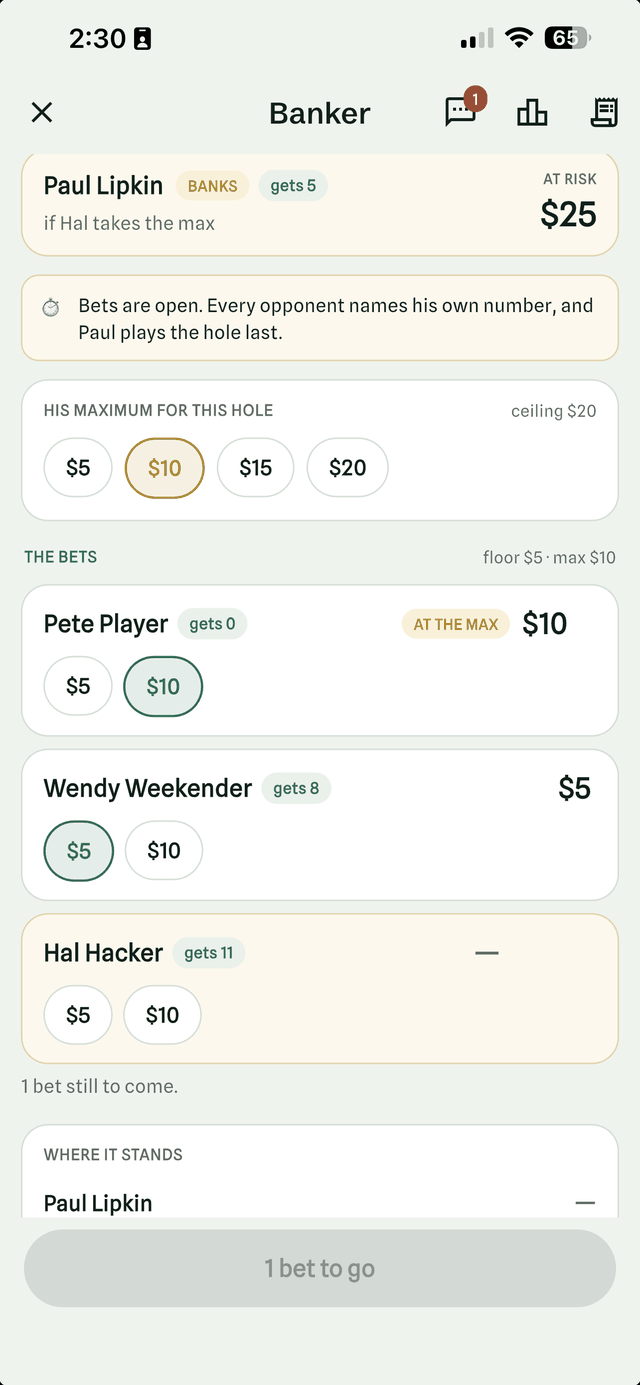
The bets are set
Before anyone hits, each opponent names his bet inside the band. Nobody may sit the hole out — the band’s floor is what everyone must have on.
2
The opponents tee off, and may double in the air
A golfer who likes what he has just hit can call the double while the ball is still in the air. It doubles his own bet and nobody else’s.
3
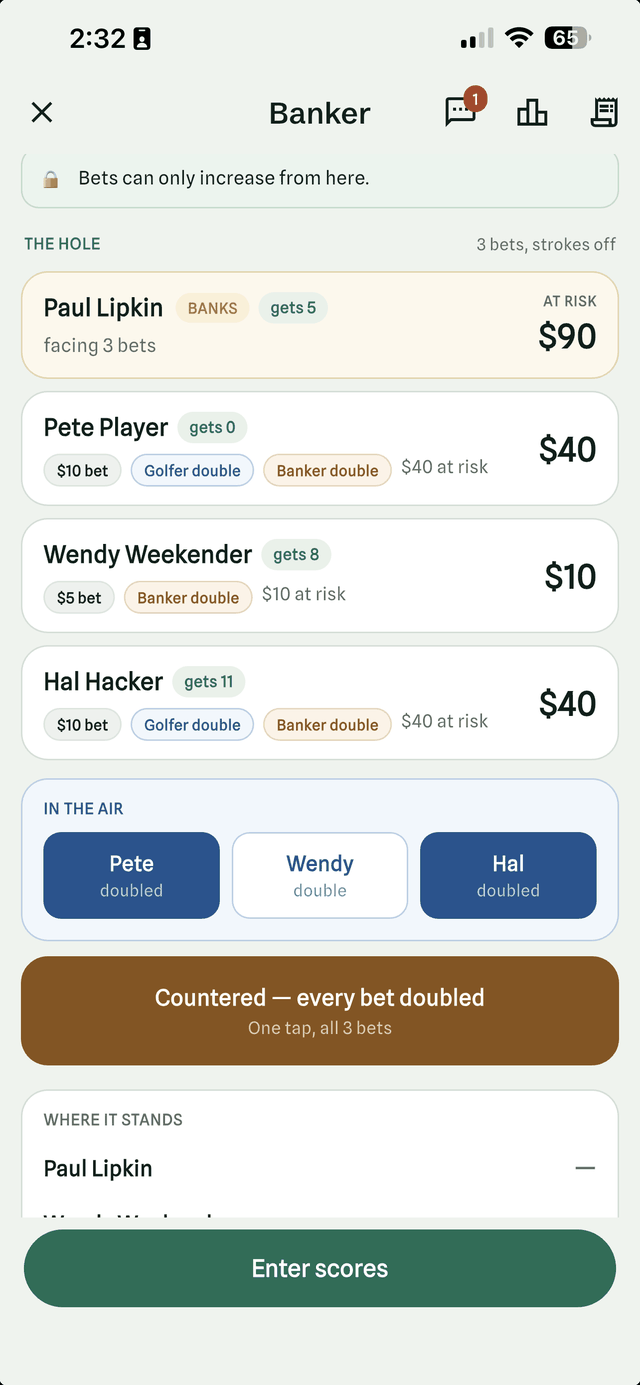
The banker hits last, then counters if he wants
He has watched three drives and hit his own, and he may then double every standing bet at once. One counter, applied to all three. This is the moment the hole is worth watching.
4
Play the hole out, then settle three bets
Each opponent’s net score against the banker’s, one at a time. Two can win while the third loses; that is normal.
The banker does not answer each drive as it happens
He waits until all three have hit and he has hit his own, and then presses once. There is no second counter and no back-and-forth — a bet is doubled at most twice, once by its owner and once by the banker.
Doubles and the counter
Four rules do all the work. Any of them can be switched off and the game still functions — it just gets quieter.
THE RULE
WHAT IT DOES
Double off the tee
before it lands
A player doubles his own bet with the banker, called while his ball is in the air. Nobody else’s bet moves.
The counter-double
banker only, after his shot
The banker doubles every standing bet on the hole. He hits last, so he is answering all three at once with one decision.
Par 3s triple
par 3 only
On a par 3 the airborne call is a triple rather than a double — a tee shot at the flag is worth more. The banker’s counter still only doubles what stands.
Birdie bonus
pays out only
A player’s birdie doubles his own collection. It never doubles the banker’s — a banker who birdies is already winning the hole three times over.
The birdie bonus is the one rule that is deliberately unfair, and it is what keeps three golfers interested in a hole the banker looks like winning.
What pays, what does not
Every one-on-one settles on net score, and each bet gets its own stroke allocation: strokes off the low man in that match, against the banker. Whichever of the two has the lower handicap plays to scratch and the other receives the difference by stroke index. It is not one allocation across the group — three bets can carry three different sets of shots.
A tie is no action. Not a carry, not a push into the next hole, not half the bet — the bet simply does not happen, and the next hole starts fresh at the band. This is the rule most groups get wrong on their first round, usually by trying to carry it.
Who strokes matters more here than anywhere
Because each bet has its own allocation, a golfer needs to know what he gets against the banker on this hole — and nothing else. Whether the man in the other bet gets a shot has no bearing on his money, and the answer changes when the banker changes. Say the strokes out loud on the tee, before the bets.
How the role rotates
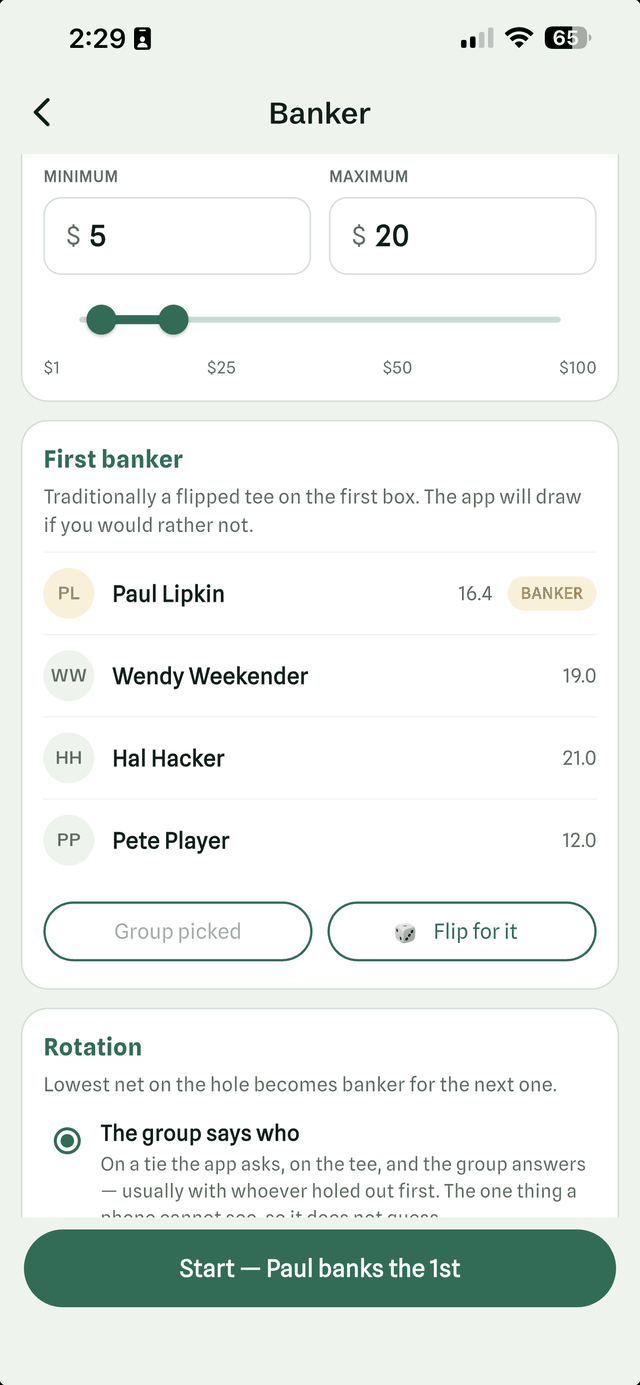
The first banker is traditionally settled by a flipped tee on the first box. After that, lowest net score on the hole banks the next one.
The traditional tiebreak is low score, holed out first — and the second half of that is the part nobody writes down. Three ways to handle it, and the group should pick one before it comes up:
The group says who
Answer it on the tee, usually with whoever holed out first. Closest to the traditional rule, and it takes one second.
Draw for it
Tied low scores go to a coin flip. Honest, and it does not ask four golfers to agree on what happened two holes ago.
The current banker keeps it
Simplest of the three. It also concentrates the role, and the exposure, on whoever is playing best — which some groups consider a feature.
What a hole can cost
This is the part to read before you agree to the numbers. Banker is the one common format where a single hole can cost a genuinely surprising amount, and it is not because the stakes are high — it is because the banker faces three bets and both sides can multiply them.
The ladder below is one hole, with a $50 ceiling on each bet:
Three opponents at the maximum$150
All three double off the tee$300
He counters$600
On a par 3, tripled instead of doubled$900
Three birdies against him$1,800
The top of that ladder is unlikely. The point is that nobody agreeing to a $50 game is picturing eighteen hundred dollars, and the multipliers are what get you there. A group that knows the ladder can set the ceiling honestly.
A cap on the hole, if you want one
One ceiling covering the whole hole — all three bets and every double inside it. This is not part of the traditional game, and groups who play Banker properly do not use it. It exists for the group that wants the format without the tail risk, and it has to be agreed on the first tee rather than invoked on the sixteenth.
Settle these first
Four questions. The first two take ten seconds; the last two are worth an actual conversation.
What is the band?
Two numbers, and they protect different people. The minimum protects the banker — it is what every opponent must have on, so nobody sits out the hole he expects to lose. The maximum protects everyone else. $5 to $50 is a different game from $20 to $25, and the width of the band is the real decision.
Who banks the first hole?
Flip a tee on the first box, or draw for it. It matters less than it feels like it should, because the role moves on the first hole anyway.
Does a player need bogey or better to collect?
A common house rule: beat the banker with a double bogey and you collect nothing. It keeps the game from paying out on ugly holes, at the cost of the format’s most confusing outcome — a hole somebody won that pays nobody. Most groups leave it off.
Can the double be called after the ball lands?
No, and this is the rule that needs stating on the first tee rather than the fourth. In the air or not at all. A double called after the ball is on the green is not a bet, it is a certainty.
Scoring it without an argument
Banker is the hardest common format to keep on paper. Every hole has three bets with three different amounts, up to two multipliers each, a birdie bonus that applies to one side only, strokes on both sides of every match, and a role that moves — eighteen times. By the twelfth hole somebody is reconstructing the ninth from memory, which is exactly how a good game ends badly.
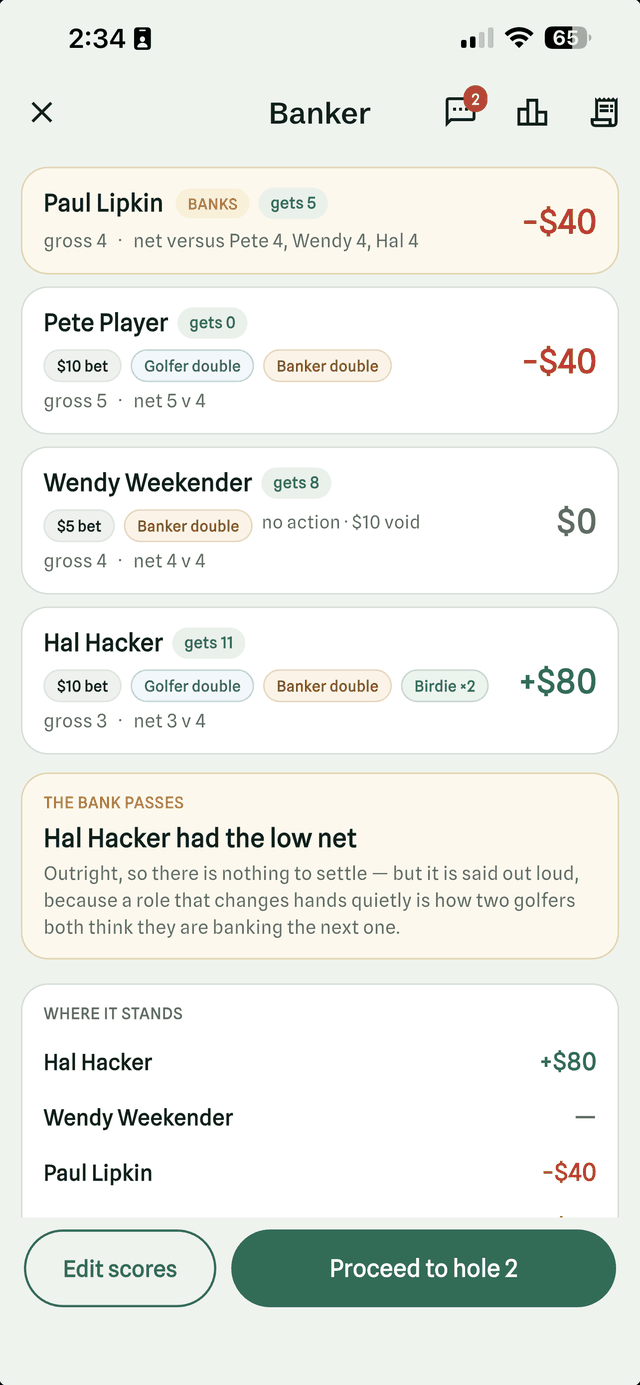
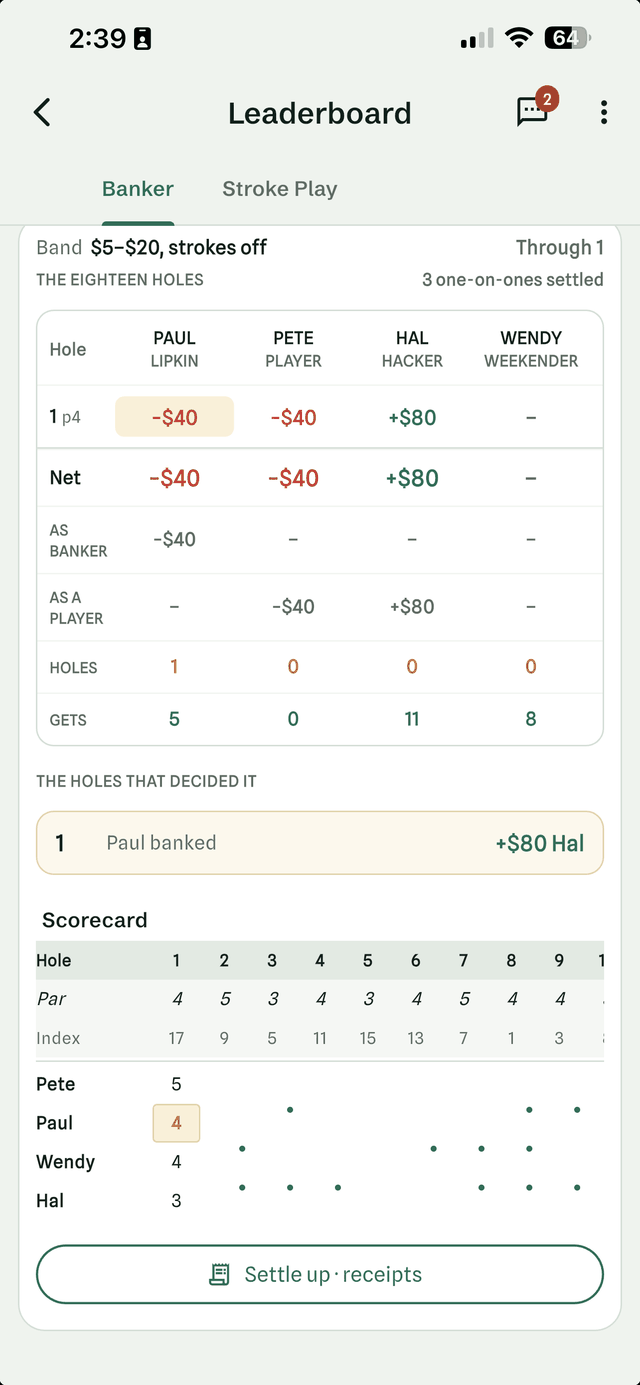
Halved holds the hole while it is live. Bets go in before the tee shots, doubles and the counter are recorded as they are called, and the three matches resolve against the banker’s net score the moment the last card is in. Nothing is reconstructed afterwards.
The chain, on every bet
$10 → $20 → $40, so the table can see how a bet got where it is rather than taking the total on trust.
Exposure while it is live
What the banker has at risk on this hole, updated as each double is called — including on the lock screen.
Who strokes, on the hole
Marked on the score box and on the card ahead, so the shots in your own bet are never a surprise.
One receipt at the end
The holes you banked itemised, the rest grouped by opponent, and the handovers reduced to as few as possible.
Agree the band first
A floor and a ceiling for every bet, who banks the first hole, and what happens on a tie.
Every opponent names his own number
The banker sees each bet as it lands, and the screen will not let him play until all three are in.
The counter, once
One tap doubles all three bets, and the notice makes it plain that bets can only increase from here.
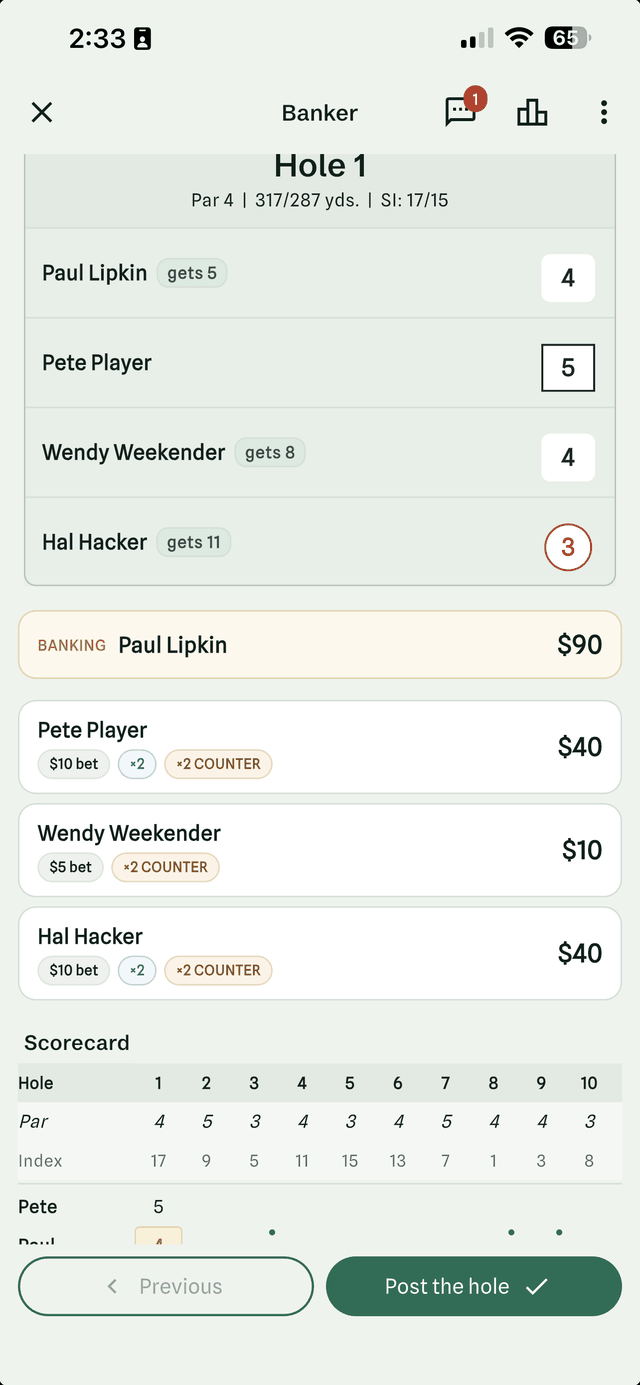
Then the scores
The bets are already fixed by the time anyone writes a number down, which is the whole point of the order.
Three bets, settled separately
Each one shows the doubles that applied and what it paid, and the handover is said out loud rather than done quietly.
Know where you stand
Money as banker and money as a player kept apart, so you can see which role has been paying you.
Fifty-four bets in a round. Somebody has to hold them.
Free for the group. Post gross scores and Halved handles the strokes, the doubles, the counter and the settlement.
Four is the game — one banker against three separate bets. Three works and is a quieter version of the same thing. Two is just a match.
Who becomes the banker?
The lowest net score on the hole banks the next one. The first banker is settled by a flipped tee or a draw. On tied low scores the traditional rule is whoever holed out first — pick that, a draw, or the current banker keeping the role, before the round.
Can the banker double the bets?
Yes — once. After his own tee shot he can counter, which doubles every standing bet on the hole at the same time. He does not answer each drive as it happens, and there is no second counter, so a bet can be doubled at most twice: once by its owner in the air, once by the banker.
What happens on a tie in Banker?
No action. That bet does not pay in either direction, nothing carries into the next hole, and the other two bets on the hole settle as normal.
Does a birdie double the money?
A player’s birdie doubles his own collection from the banker. A banker’s birdie doubles nothing — he is already winning three bets on that hole, and doubling all three at once would make the role too strong.
How much can you lose on one hole?
More than the ceiling suggests. With a $50 maximum, three bets at the max are $150, all three doubling makes $300, the counter makes $600, a par 3 triple makes $900, and three birdies against the banker makes $1,800. Agree the band knowing the ladder, and add a cap on the hole if the group wants a rail.
Is Banker played on net or gross?
Net, and the strokes are worked out match by match against the banker — not once across the group. In each one-on-one the lower handicap of the two plays to scratch and the other receives the difference, allocated by stroke index. So the shots you get can change from hole to hole as the banker changes.