The game for a threesome. Every hole is worth nine points split between the three of you, so nobody is ever out of it and a blow-up on the 6th costs you one hole rather than the round.
THE SHORT ANSWER
Three golfers. On every hole the low net score takes 5 points, second takes 3 and third takes 1. Tied golfers split the points they are tied for, so the hole always pays exactly nine. Three points a hole is par, which makes 54 the number to beat over eighteen.
NINE POINTS A HOLE
outright, then a tie
HOLE 7 · PAR 4 · SI 5GROSS → NET → POINTS
Paul
4→3
1 STROKE
5 pts
Sam
4→4
3 pts
Dave
5→5
1 pt
the hole always pays9
HOLE 8 · PAR 4 · SI 11TWO TIE FOR LOW
Paul
5→4
1 STROKE
4 pts
Sam
4→4
4 pts
Dave
5→5
1 pt
5 and 3 split two ways9
Gross scores go in, the stroke comes off, and the three nets rank 5, 3 and 1.
Paul’s stroke brings him level with Sam, so they share the 5 and the 3 — 4, 4 and 1. The hole still pays nine.
3
golfers, exactly
9
points a hole, always
54
points is par for the round
162
points on the table
The rules
Three golfers play their own ball for eighteen holes. On each hole the three net scores are ranked, and points go out by finishing order: 5 to the low score, 3 to the middle, 1 to the high. Nobody is eliminated, nothing carries, and the next hole starts from scratch.
That is the entire format. What makes it worth knowing is the consequence of those three numbers adding to nine: every hole pays exactly nine points however the scores fall — a birdie against two doubles pays nine, and three pars pay nine. The game never gets louder or quieter. It just keeps handing out nine points a hole for eighteen holes.
Why a threesome plays this and not Skins
Skins pays the outright winner of a hole and nobody else, so three golfers who all make par get nothing and a carry builds. Points 5-3-1 pays all three of them, every hole, and turns the whole round into one long ladder. It is the gentler game, and it is the one where second place is worth something.
How ties split
This is the one part of the format that loses people, and it follows from the nine. Tied golfers share the points for the places they are tied for. Two golfers tied for low are sharing 5 and 3, so they take four each — not five each, and not five and three decided by some other measure.
THE HOLE
WHAT IT PAYS
Three different scores
5 · 3 · 1. The ordinary hole.
Two tie for low
They split 5 and 3 — four each — and third still takes his 1.
Two tie for second
Low takes his 5; the other two split 3 and 1 at two each.
All three tie
Three each. Which is par, and the hole has cost nobody anything.
There is no case that does not add to nine, which is also how you check a card by hand: if a hole does not total nine, somebody has written it down wrong.
Why par is 54
Nine points divided three ways is three points a hole, so a golfer holding his own against the other two collects three a hole and 54 over eighteen. That number is what the standing should be read against — not the raw total.
So 27 points after nine holes is dead level, 62 for the round is a good day, and 41 is a bad one. Three golfers between them always finish on 162, which means one golfer’s gain is exactly the other two’s loss. There is no such thing as a round where everybody did well.
3
points a hole is par. Hold that and you owe nothing.
54
for the round. The only number worth remembering.
162
across the three of you, every time. A closed system.
Handicaps
Points are awarded on net score, hole by hole, so the strokes have to be allocated before the round rather than subtracted from a total at the end. Each golfer gets his shots on the holes his course handicap says, by stroke index, and on those holes his net score is what the points are ranked on.
The usual approach in a threesome is to play off the low golfer: he plays to scratch within the game and the other two receive the difference. It keeps the arithmetic small and it means a shot received is always a shot that matters. Gross is a perfectly good alternative if the three of you are close enough in ability that nobody has to ask.
A stroke is worth more here than in most games
In a Skins game a shot received either wins the hole or does nothing. Here it can move a golfer from 1 to 3, or from 3 to 5, and it does so on every hole he gets one. Over eighteen holes that compounds, which is why groups who play this every week tend to argue about the allowance rather than about the format.
Turning points into money
The stake is a rate per point, not a pot. At a dollar a point a golfer who finishes on 62 is eight points clear of par and the settlement follows from there. What differs between groups is how the points become money, and there are three sensible answers.
They are not variations on the format — the points are identical under all three. They differ only in how much a bad round can cost you.
Against the average
GENTLEST
You settle against the field’s average, so a middling round costs nothing. With three golfers the average is always 54 — par — which makes this the same as settling on your distance from 54. Eight points clear at a dollar a point is eight dollars, and it comes out of the two below you.
Everyone above you
You pay each golfer who beat you the difference between your totals, and collect from each golfer below. Second place is a real position: you take money off third and hand some to first. This is the harshest of the three on last place, because he pays both of the others.
Winner only
Only the leader collects. The other two each pay him their difference and settle nothing between themselves, so second and third is a distinction without a price. Simple, and it makes the whole round about one question.
Cap the damage if you like
Because the points keep accruing whether or not you are in contention, a genuinely bad round can run up a number nobody intended. A cap on what any one golfer can lose fixes that, and it is worth setting before the first tee rather than on the sixteenth. Most groups never need it; the ones playing for real money set it once and forget it.
Settle these first
Three questions, and all of them take less time to answer on the first tee than to argue about on the ninth.
What happens if somebody picks up?
He has to take a score, because the hole cannot pay nine without three of them. The standard answer is that a golfer who does not hole out takes the high score and its 1 point. Say it once and nobody has to negotiate it while the group behind waits.
Net or gross?
Net is the default and the right call in almost any threesome, since points go out hole by hole and an unaided nine-shot gap would decide the round by the fourth tee. Gross is fine between golfers of similar ability.
Does the fourth man join or wait?
Neither. The format is built on three scores adding to nine, so a fourth golfer breaks it. If somebody turns up on the first tee, play a different game rather than trying to stretch this one — Skins takes two to four and needs no rewriting.
Scoring it without a spreadsheet
Nine points a hole is arithmetic nobody can run while walking to the next tee. Three net scores have to be ranked, ties split, points totalled, measured against three a hole, and multiplied by the stake — eighteen times. Groups who keep this on paper usually end up adding it up in the car park, which is the one place the number stops being interesting.
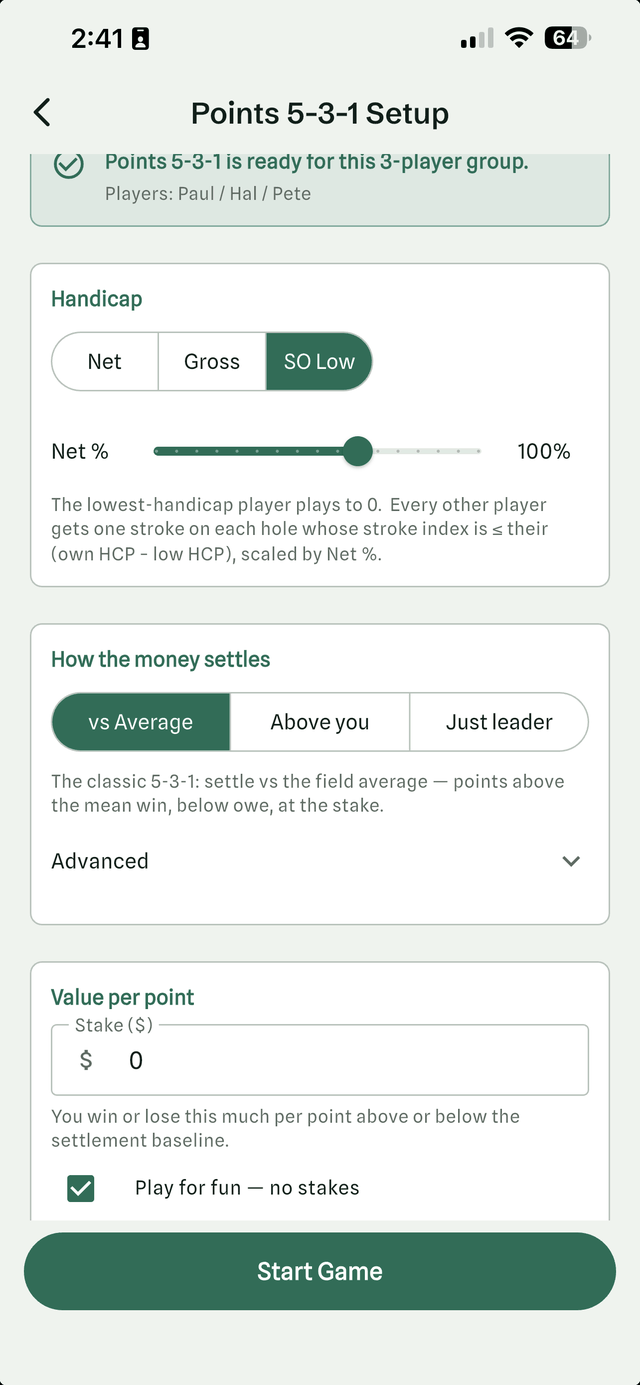
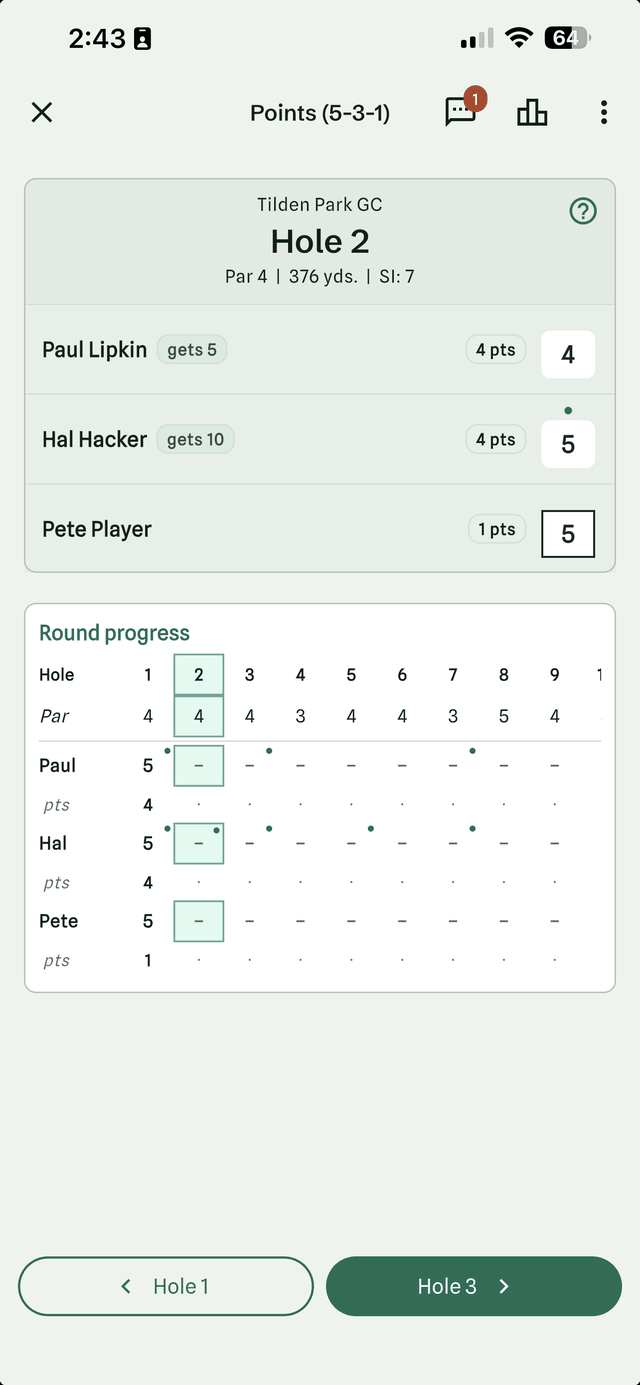
Halved resolves every hole as it is posted. You enter gross scores; it applies the strokes, ranks the three, splits any tie, shows the hole paying its nine, and keeps a running standing with each golfer’s distance from par and the money that currently implies.
Every hole shows its nine
Three scores turning into 5, 3 and 1, with the total underneath so the table can check it.
Ties split visibly
Tied golfers are drawn together with the same number, so four and four never looks like a mistake.
Points, par and money
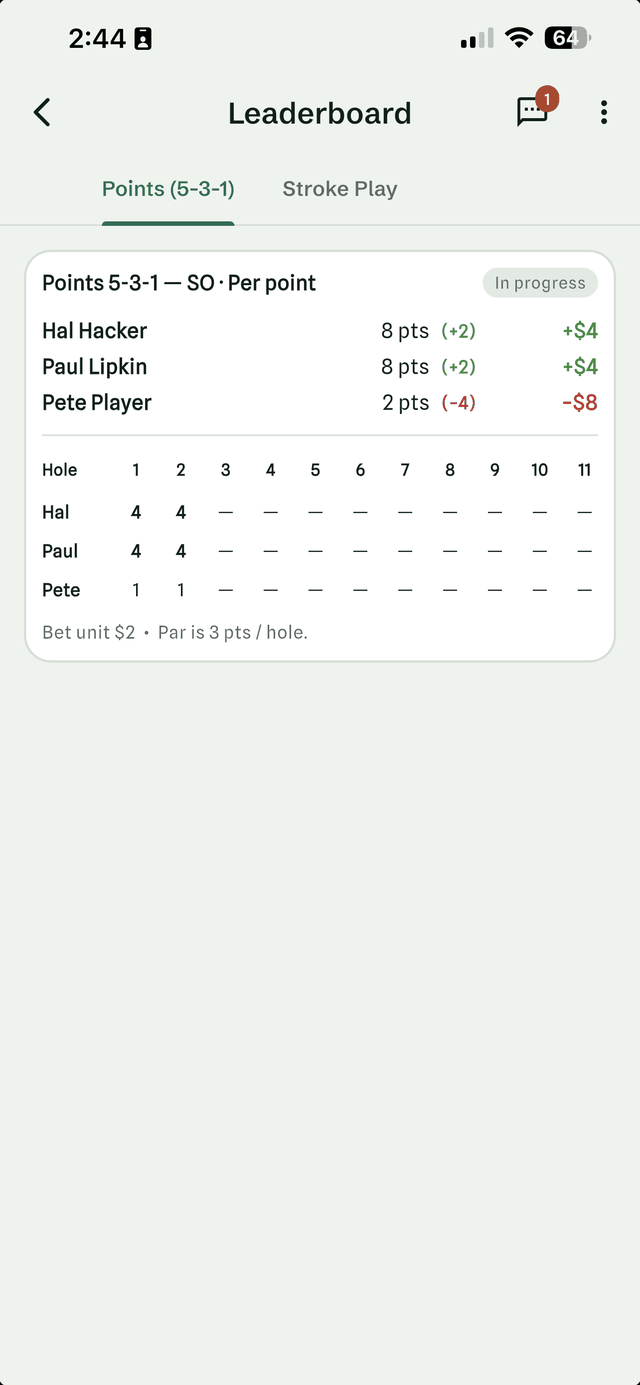
The standing carries all three, so nobody has to subtract 54 in his head on the 14th tee.
Set it up once
How the strokes come off, how the money settles, and what a point is worth — the three choices that decide the day.
The points, as the hole happens
Two 4s tie for the low net and split, so the hole reads 4, 4 and 1 — and still totals nine.
Know where you stand
Points, the figure against par, and the money side by side, with the reminder that par is three a hole.
Nine points a hole, worked out for you.
Free for the group. Post gross scores and Halved handles the strokes, the ties, the running total and the settlement.
Nine, always. Five for the low net score, three for the middle and one for the high, and any tie splits the points for the places tied. If a hole does not add to nine it has been scored wrong.
What happens when two golfers tie for low?
They share the 5 and the 3, so they take four points each, and the third golfer still takes his 1. Two tied for second share the 3 and the 1 at two each while low takes his 5. All three tied take three each.
What is a good score in Points 5-3-1?
Par is 54 — three points a hole over eighteen. Anything above 54 means you took more than your share, and the three golfers always total 162 between them.
Can you play 5-3-1 with four golfers?
No. Three points values for three finishing positions is what makes every hole pay nine, and a fourth golfer has no place to go. Four-player games with the same feel are Skins and Wolf.
Is 5-3-1 played on net or gross scores?
Net, normally, with strokes allocated by stroke index before the round so each hole can be ranked as it is played. Most threesomes play off the low golfer. Gross works when the three are close in ability.
How do you settle the money?
The stake is a rate per point. Settling against the field average is the gentlest and, with three golfers, is the same as settling on your distance from 54. The alternatives are paying everyone who finished above you, or paying the winner only.